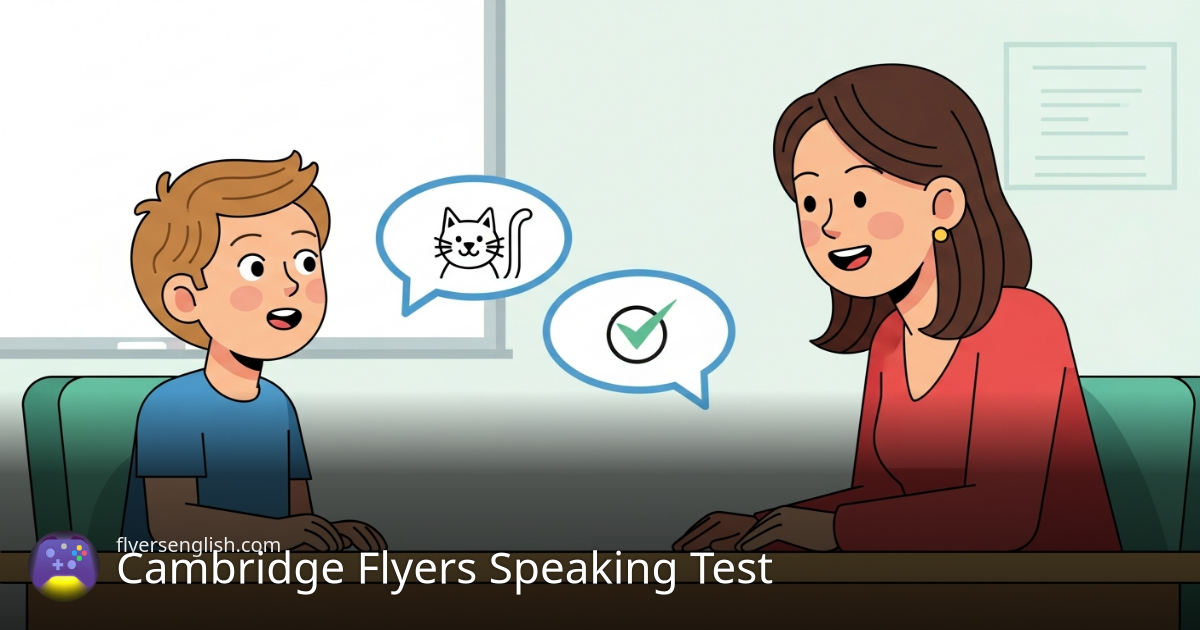
Overview of the Cambridge Flyers Speaking Test
The Speaking test is worth a maximum of 5 shields out of the total 15 shields in Cambridge Flyers. There is no fixed script; the examiner uses Cambridge-provided materials and adapts to each child's responses. Cambridge assesses across four areas: pronunciation, vocabulary range, grammatical accuracy, and natural interaction with the examiner.
Part 1: Find the Differences Between Two Pictures
The examiner and candidate each hold a different version of the same picture, with small details changed. The child's task is to describe their picture and identify the differences. Skills tested: Describing location, colour and quantity; using comparative language; asking and responding in dialogue. Useful phrases: • "In my picture, the boy is wearing a red hat. What about in yours?" • "There are two cats in my picture. How many are in yours?" • "The girl is sitting next to the tree in my picture. Is she in yours too?" Common mistakes: Only describing their own picture without asking questions; stopping after 1–2 differences.
Part 2: Arrange Picture Cards and Tell the Story
The examiner gives the child a set of picture cards showing a story sequence (usually 4–5 cards). The child arranges them in the correct order and then narrates the story. Skills tested: Time connectors, past simple and past continuous tense, coherent storytelling. Useful phrases: • "First, Tom woke up and saw the sun shining." • "Then, he decided to go to the park with his dog." • "After that, it started to rain so they ran home." • "Finally, they sat inside and drank hot chocolate." Common mistakes: Describing each picture separately; overusing "and then"; using present tense when narrating.
Part 3: Odd One Out (Identify and Explain)
The examiner points to a group of 4–5 images and asks the child which item doesn't belong and why. Children must explain in a complete sentence. Useful phrases: • "The banana doesn't belong because the others are all vegetables." • "I think the guitar is different because it's a musical instrument, not a sport." • "The whale doesn't fit because all the others live on land."
Part 4: Personal Questions
The examiner asks questions about the child's own life, preferences and experiences. Children still need to answer in full sentences, not just "yes" or "no". Useful phrases: • "Do you enjoy visiting parks?" → "Yes, I love it. I usually go there with my family at weekends." • "Have you ever tried cooking?" → "Yes, I have. I helped my mum make soup last week." Common mistakes: One-word answers; not expanding answers with details or examples.
How to Support Speaking Practice Between Lessons
- Ask simple English questions daily: "What did you do today?" "Have you ever...?"
- Look at pictures together and ask children to describe what they see in complete sentences
- Read picture books and pause to ask children what happens next
- Remind children to always give a full answer: not "Yes" but "Yes, I do, because..."
- Vocabulary practice through Vocabulary Tower and Listen & Choose on Flyers English builds the word range needed for Speaking
Summary
The Cambridge Flyers Speaking test rewards natural interaction, appropriate vocabulary and a willingness to communicate, not perfection. A child who speaks confidently, answers in full sentences and uses time connectors will consistently outperform a child who is technically accurate but passive.