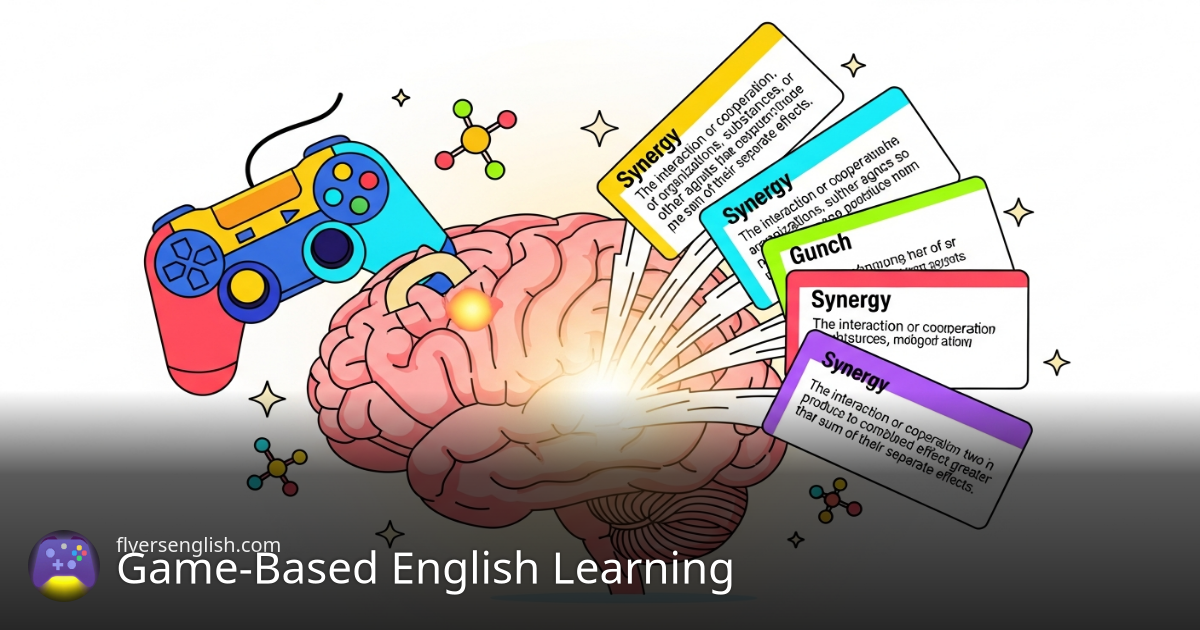
Many parents worry when they see their child 'playing games' instead of studying. But neuroscience tells a different story: well-designed learning games can be a highly effective revision tool that helps children consolidate knowledge from class sessions significantly faster. Here's the science behind it.
The Science Behind Game-Based Learning
Dopamine and Memory: When children play games and achieve goals (levelling up, earning badges, beating a stage), the brain releases dopamine, a neurotransmitter linked to pleasure and motivation. Dopamine doesn't just feel good; it also strengthens connections between neurons, which makes new information easier to retain long-term.
Active Recall: In vocabulary games, children must retrieve words from memory to answer, which is called 'active recall'. Research on retrieval practice, including Karpicke and Blunt's 2011 study at Purdue University, found that practising retrieval produces greater gains in meaningful learning than elaborative study methods such as concept mapping. Every time a child plays Vocabulary Tower or Word Blaster, they practise active recall dozens of times.
Spaced Repetition: Good language games automatically re-present vocabulary at scientifically calculated intervals, moving words from short-term to long-term memory. Flyers English's Flashcard system automatically sorts vocabulary into 3 mastery levels and schedules optimal review timing, perfect for reinforcing what children have been taught in class.
Why Traditional Methods Alone Can Be Limiting for Young Learners
Traditional revision methods (reading textbooks, copying, rote memorisation) have some inherent limitations for children aged 7–12 outside of class:
- No immediate feedback: children make mistakes without realising, reinforcing errors
- Passive and one-directional: the brain does not actively process information
- No immediate reward: without instant positive reinforcement, children lose focus after 20 minutes
- Incompatible with young brains: children aged 7–12 need movement and interaction
How Flyers English Applies Game-Based Learning
Instant AI Feedback
Google Gemini AI analyses children's written stories immediately: it highlights grammar errors by colour, suggests richer vocabulary alternatives, and evaluates story coherence. This instant feedback helps children self-correct between class sessions.
Adaptive Learning
The system automatically adjusts difficulty based on each child's results. Children are always challenged at exactly the right level. This is the 'Flow State' principle described by psychologist Mihaly Csikszentmihalyi.
Gamification
XP points, achievement badges, leaderboards and daily streaks create intrinsic motivation. Children want to practise more not because they are forced to, but because they want to beat their own score.
Short Sessions Matched to Attention Span
Each Flyers English session is just 10–15 minutes, matched to the typical attention span of children aged 7–12. With 3,600+ short, varied exercises, no two sessions feel the same.
Flyers English vs Regular Entertainment Games
| Criteria | Flyers English | Regular entertainment games |
|---|---|---|
| Content | Official Cambridge YLE curriculum | Unrelated to exam preparation |
| Advertisements | No ads | Typically ad-supported |
| Progress tracking | Family progress summary included | None |
| Feedback | Google Gemini AI instant feedback | No academic feedback |
| Goal | Cambridge YLE exam ready | Pure entertainment |
Summary
Game-based learning is a method supported by neuroscience and proven to work. For children preparing for Cambridge YLE, the combination of centre learning and daily game-based revision creates a powerful learning loop: teachers introduce new content, children review and retain it through games, and progress accelerates in the next class session. The key is choosing the right platform: one specifically designed for Cambridge YLE, with adaptive feedback and no distracting ads.