How kids learn here
Children remember a word when they meet it again and again, with time in between. This page explains how our games do that, what is not built yet, and the research we lean on.
What your child gets today
These are in the product now.
Words from the Cambridge wordlists
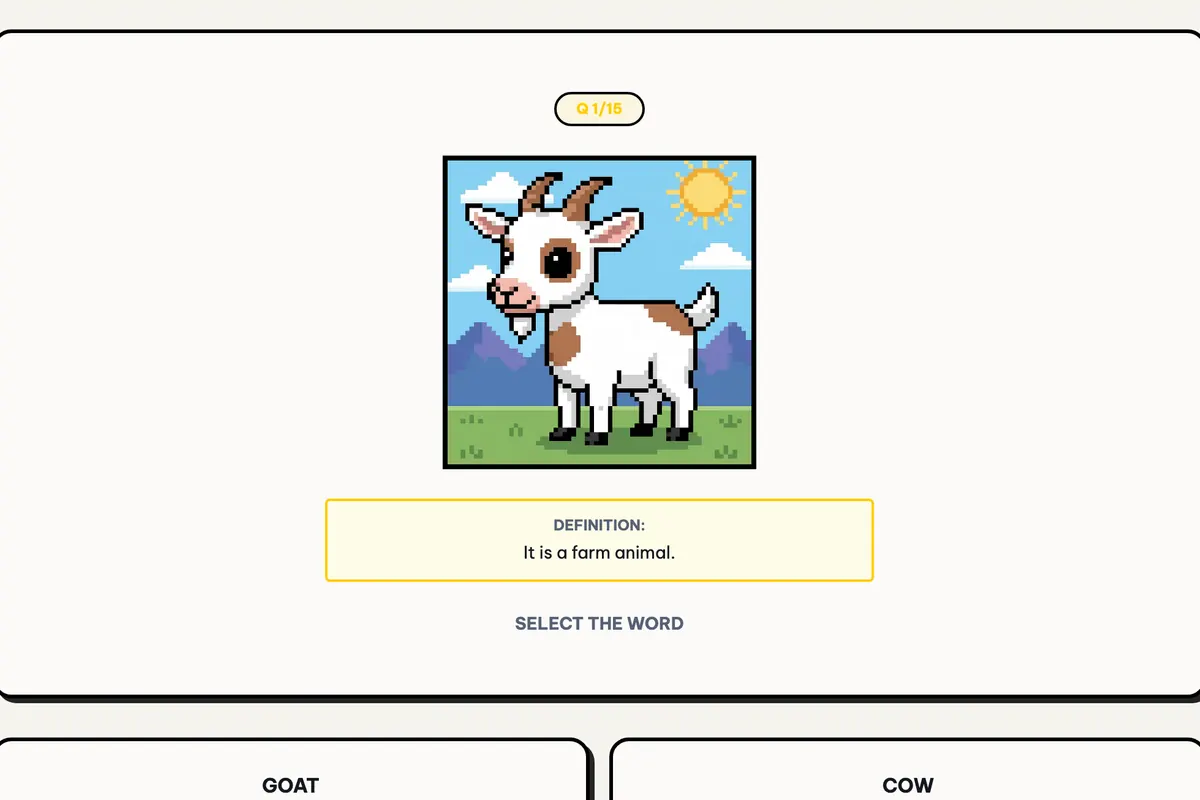
The games are built on the Cambridge Young Learners wordlists for Starters, Movers and Flyers. Your child practises the words the exams use.
Words come back for review
After your child answers a word, we plan when to show it again. The plan follows what your own child answered, not a fixed timetable for everyone.
Mistakes get a second look
In some games, such as Sentence Builder and Listen & Choose, a wrong answer pauses the game so your child can see the right one. The same question comes back later in the round.
Sleepy words in My Town
Words your child has learned live in My Town. When a word is due for review, it goes sleepy. Answering it right again wakes it up.
A short session each day
The Today page lines up a few activities for the day. It is meant to be short, so it fits in before dinner or after homework.
A weekly email for parents
Once a week we email you a summary. It is built from what your child actually did that week.
Vietnamese meaning on tap
In the word games, your child can tap a button to peek at what a word means in Vietnamese. The task itself stays in English.
How review works
The first review comes about a day after your child gets a word right. Each time they get it right again, the wait roughly doubles.
- About 1 day
- About 2 days
- About 5 days
- About 11 days
The wait keeps growing, up to about two months. No word leaves review for longer than that.
If your child gets a word wrong, it comes back the same day and the count starts again. That is normal. It is how the hard words get the most practice.
What we don't claim
- Stars, badges and streaks are there for fun. They don't teach English. The practice does.
- We don't promise a score or a number of words remembered. Every child is different, and we would rather show you your own child's real activity each week.
- Many of our games ask a child to choose the right answer. Saying, spelling and building the answer is harder and more useful. Some games do this already, and we want more of them to.
What we're building next
These are not in the product yet. We list them so you know where we are going.
Narrated stories
Stories your child can listen to more than once, with a small task each time.
Sound practice for Vietnamese speakers
Practice with the English sounds that Vietnamese speakers often find hard, such as the consonants at the end of a word.
The research behind it
A few of the studies we used when deciding what to build.
- Kim & Webb (2022). Spreading practice out over time works better than doing it all at once.
- Uchihara, Webb & Yanagisawa (2019). Meeting a word more times helps a learner pick it up.
- Lyster & Saito (2010). Prompting a learner to try again helps more than just giving the answer.
- Yanagisawa, Webb & Uchihara (2020). Seeing a word's meaning in your first language helps with vocabulary.
- Habgood & Ainsworth (2011). Children learned more when the game itself was the learning task.
- Sailer & Homner (2020). The effects of points and badges on learning are modest.
Much of this research was done with teenagers and adults. Studies with primary-age children are fewer, so we treat these findings as a guide and not a guarantee.
See where your child is now
The level check takes about 15 minutes and needs no account.