A1 Movers Listening Part 1 — Match Names to People
In Movers Listening Part 1, your child sees one big picture of people doing different things, with names printed around it. They listen to an adult and a child talking and draw lines from five names to the right people.
How Movers Listening Part 1 works
Your child opens the page to one big scene — a park, a street, a beach — full of people doing different things, with names printed around the edge.
An example is matched first, so everyone knows the job: draw a line from a name to a person.
The dialogue begins — an adult and a child talk about who is who: 'Can you see the girl feeding the ducks? That's Daisy.'
Your child draws five lines, one for each question, while some names are never used at all.
The recording plays a second time, giving a full pass to check and fix any line.
Tips to prepare for Part 1
Use the pause before the audio well: have your child note what each person is doing and wearing — the dialogue identifies people by exactly those details, not by where they stand.
Some names are left over at the end — that is by design, not a mistake to fix.
Learn the first names on the Movers wordlist so none of them sounds new on test day; an unfamiliar name costs seconds of confusion.
Draw lines lightly on the first listen, then confirm on the second playing — changing an answer costs nothing.






Practise Part 1 with these games
- Listen & Choose
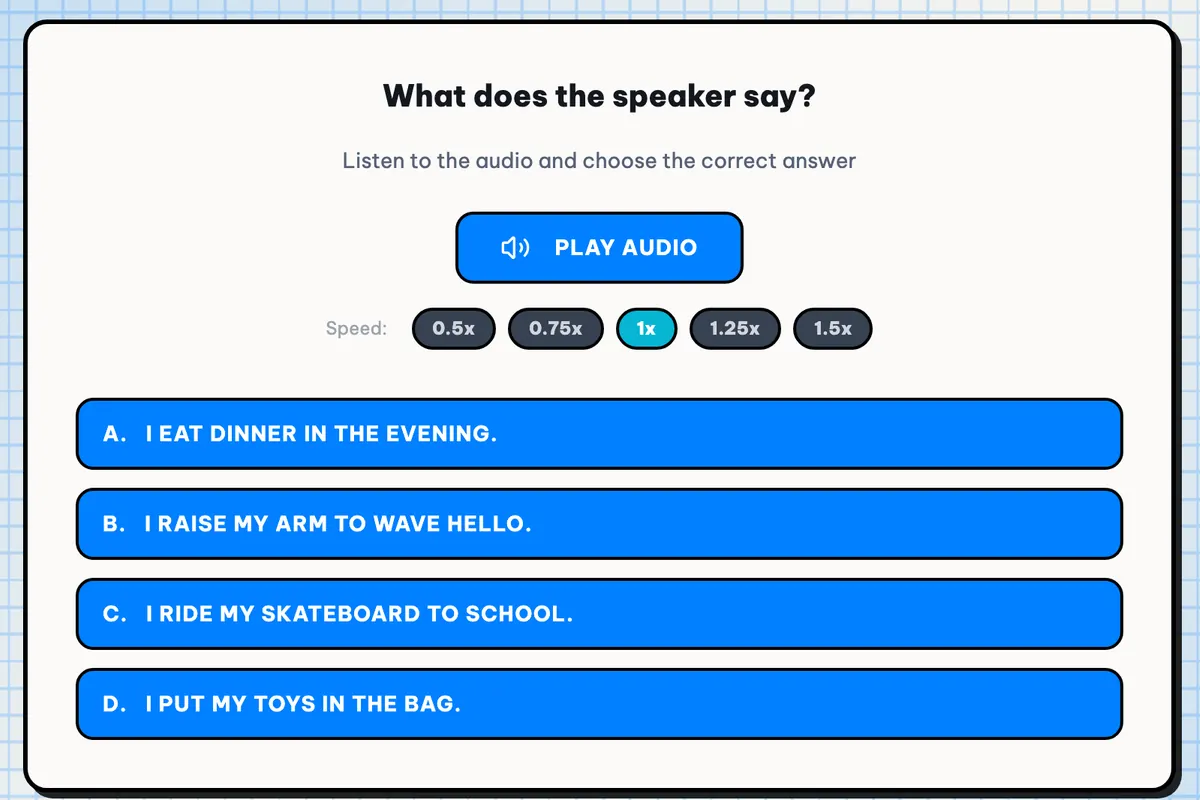
Hear a description, pick the person or object that matches — the same listen-then-identify skill Part 1 tests with names.
- Sound Arena
Audio-first rounds sharpen the careful listening Part 1 needs — catching who is doing what before drawing a single line.
Good to know
Frequently asked questions
How many questions are in Movers Listening Part 1?
Five. Your child sees one big picture and a set of printed names, listens to a conversation between an adult and a child, and draws five lines connecting names to the correct people. One extra matching is usually done as an example before the questions begin, so children know exactly what to do.
Does my child hear each recording more than once?
Yes. Every listening recording in the Cambridge YLE tests is played twice, and Movers Part 1 is no exception. Teach your child to draw their best-guess lines on the first playing, then use the second playing to check and correct — there is no penalty for changing an answer.
Does my child need to write anything in Part 1?
No writing at all — Part 1 only asks children to draw lines from names to people, so spelling is never marked here. What matters is recognising spoken names quickly and catching the describing details: what someone is wearing, where they are standing and what they are doing.
Can a child fail A1 Movers?
No — there is no pass or fail. Every child receives a certificate with up to five shields for each paper: Listening, Reading & Writing, and Speaking, fifteen in total. Around ten shields with at least two per skill is generally treated as a strong result and a green light for Flyers.
Last updated: 2026-07-02
Ready to practise Listening Part 1?
Make a free account and your child can start in under a minute. No card needed.